# Live rear axles
> How a live (beam) rear axle works in opensus and how to build one from parts, with dependent parts picked across the axle, a Panhard rod, centerline points and rubber bushings.
A live axle carries both wheels and the differential in one rigid housing. The wheels cannot move apart from each other: one rising tilts the whole axle, and neither wheel changes camber against the other. What the layout decides is where the axle is held: its links set the roll center, the anti-squat and how much the axle steers as the body rolls.
There is no live axle under **Suspension → Type**: you build the axle from points and parts, as for any [custom linkage](/docs/custom-linkages/). Two complete ones are ready to open and adapt, each with its own page:
| Layout | Links | Page |
|---|---|---|
| 3-link with a torque arm | Two lower trailing arms, a Panhard rod and a torque arm | [3-link live axle](/docs/three-link-live-axle/) |
| 5-link | A lower and an upper link each side, and a Panhard rod, on rubber bushings | [5-link live axle](/docs/five-link-live-axle/) |
## Build one from parts
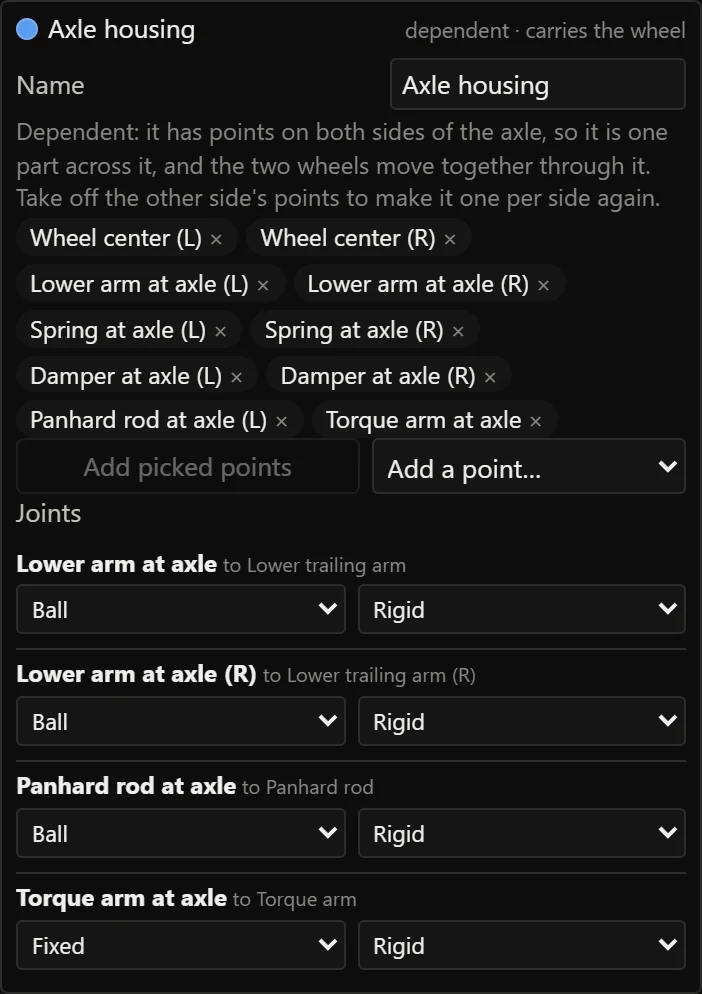
Every point is drawn on both sides of the car: you place it on one side and the other side gets its mirror. A part takes whichever copies you pick with the **Part** tool in the 3D view. Pick points on both sides of the car and you get one part across the axle, a **dependent** part, and the part card says so.
- **The housing** is one dependent part: pick both wheel centers and both sides' axle ends of the links, then **Make part**.
- **Trailing links** are two-point parts on one side, made on each side as on any corner.
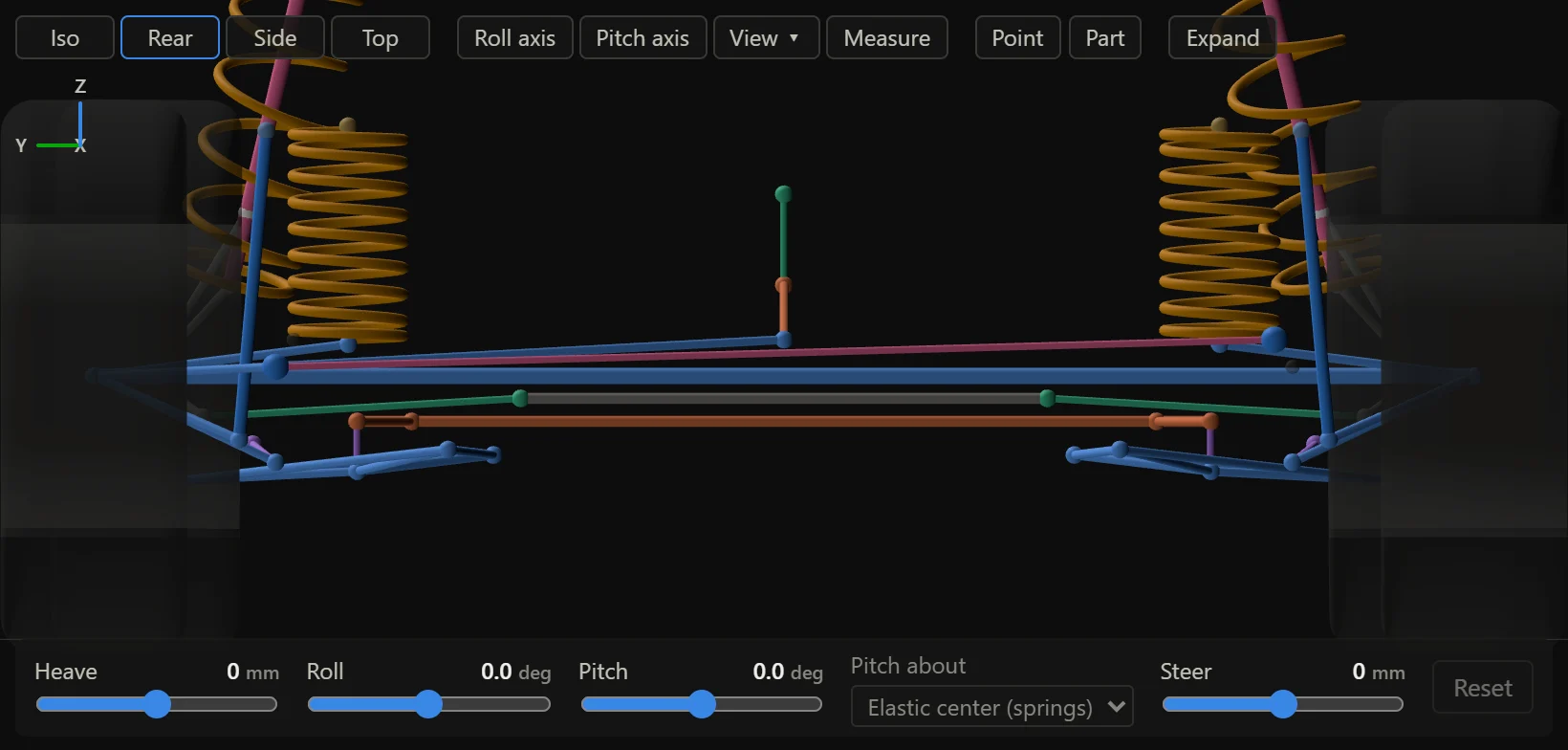
- **The Panhard rod** runs from one side of the axle to the other side of the body. Place its two points, then pick the axle end on the left and the chassis end's copy on the right: the rod is dependent, so there is one of it. Keep it clear of the springs and the housing; the examples put it behind the axle.
- **Points on the centerline** (Y = 0), such as a torque arm's, are one point for the whole axle. A part made only of them, such as the torque arm itself, is one part.
- A one-off part off the centerline, such as an offset torque arm or a single upper link, is ticked **On this side only** in its card: one part, not mirrored.
The 3-link's Axle housing: dependent, with each side's points marked (L) or (R). The torque arm mount, on the centerline, is one point. Click to enlarge.
Copies of a point that nothing uses stay in the 3D view, greyed out, and can still be picked. In the point table, a badge beside each name says which copies are used: **R** for the right side only (shown, and typed, at its right-side Y), **L** for the left only, **C** for the centerline. To split a dependent part back into one per side, take the other side's points off it.
From behind: the Panhard rod (pink) from the left of the axle to the right side of the body, its two ends picked across the axle. Click to enlarge.
With anything dependent, the axle is solved as one mechanism, both wheels together, and the status under **Suspension** reads **sides linked**. A rigid housing has six freedoms and needs two, heave and roll, so it takes exactly **four links**, or more on rubber bushings (see the [5-link](/docs/five-link-live-axle/)). The status names any missing or extra.
A part that is bolted to the housing, such as a torque arm, shares one point with it. Set that joint to **Fixed** under the part's **Joints**, or it is a ball joint.
## Read the results
| Result | On a live axle |
|---|---|
| Camber | When both wheels rise together, the axle stays level and camber does not change. When the body rolls, the axle stays on the road, so camber **to the road** stays at about 0° while camber **relative to the body** changes by the roll angle. |
| Roll center | Near the Panhard rod's height on the centerline, measured at the axle line |
| Motion ratio | About 1 with both wheels moving together, in the **Ride, at design** readout and on the Heave chart: springs mounted on the axle follow it. The 3-link example reads 1.024 and the 5-link 1.009. |
| Roll stiffness | From the springs' spacing, not the track (each spring works at its own distance from the middle), plus any bushing bind |
| Loads and compliance | Solved over the whole axle, with both wheels' forces; the Panhard rod takes the cornering force, and bushed joints give at their rates |
Transient events take longer on a linked axle: its positions are solved as the simulation runs, rather than read from a table.
Source: https://opensus.app/docs/live-axle/ (last updated 2026-11-22)