 opensus
Ackermann: how the steered wheels share a turn
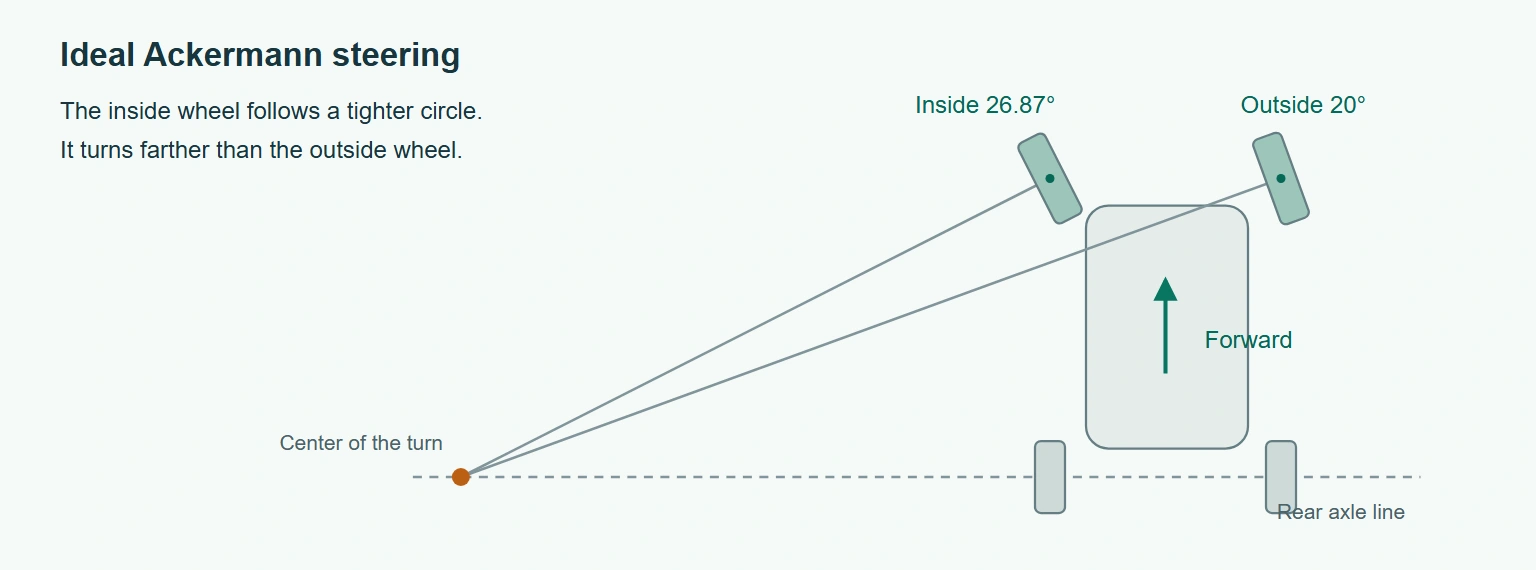
In a turn the inside front wheel follows a tighter circle than the outside one, so for neither tire to scrub at low speed it has to steer further. Ackermann geometry is the steering layout that gets this exactly right at walking pace: both front wheels' axes meet at one point on the line of the rear axle, the center of the turn.
The ideal inner angle
With wheelbase and front track , an outer wheel steered by needs the inner wheel at where
so
For a 1200 mm track and a 1550 mm wheelbase, an outer wheel at 20° wants the inner at 26.87°.
Percent Ackermann
How close a real linkage comes is usually given as a percentage, but there is no single standard: some tools compare the angle difference at one steer angle, some compare the inner wheel's angle to the ideal one, and some fit a line through the whole travel. opensus uses the angle difference against the ideal angle difference, at every point of the steering sweep:
with the ideal inner angle taken from the actual outer angle, the track at the design position and the wheelbase.
- 100% is true Ackermann.
- 0% is parallel steer: both wheels at the same angle.
- Below 0 is anti-Ackermann (reverse Ackermann): the outer wheel steers more than the inner. The inner wheel is always the one on the side the car turns to, so this shows as a negative number rather than as a small positive one.
- Over 100% steers the inner wheel past the ideal.
Angles are measured from straight ahead, so static toe does not count as steering. Below 1.5° of outer steer the two differences are both tiny and their ratio means nothing, so opensus leaves those points out of the Kinematics → Steer → Ackermann chart.
Using the numbers above, an inner wheel at 24° with the outer at 20° is 58% Ackermann.
Worked example
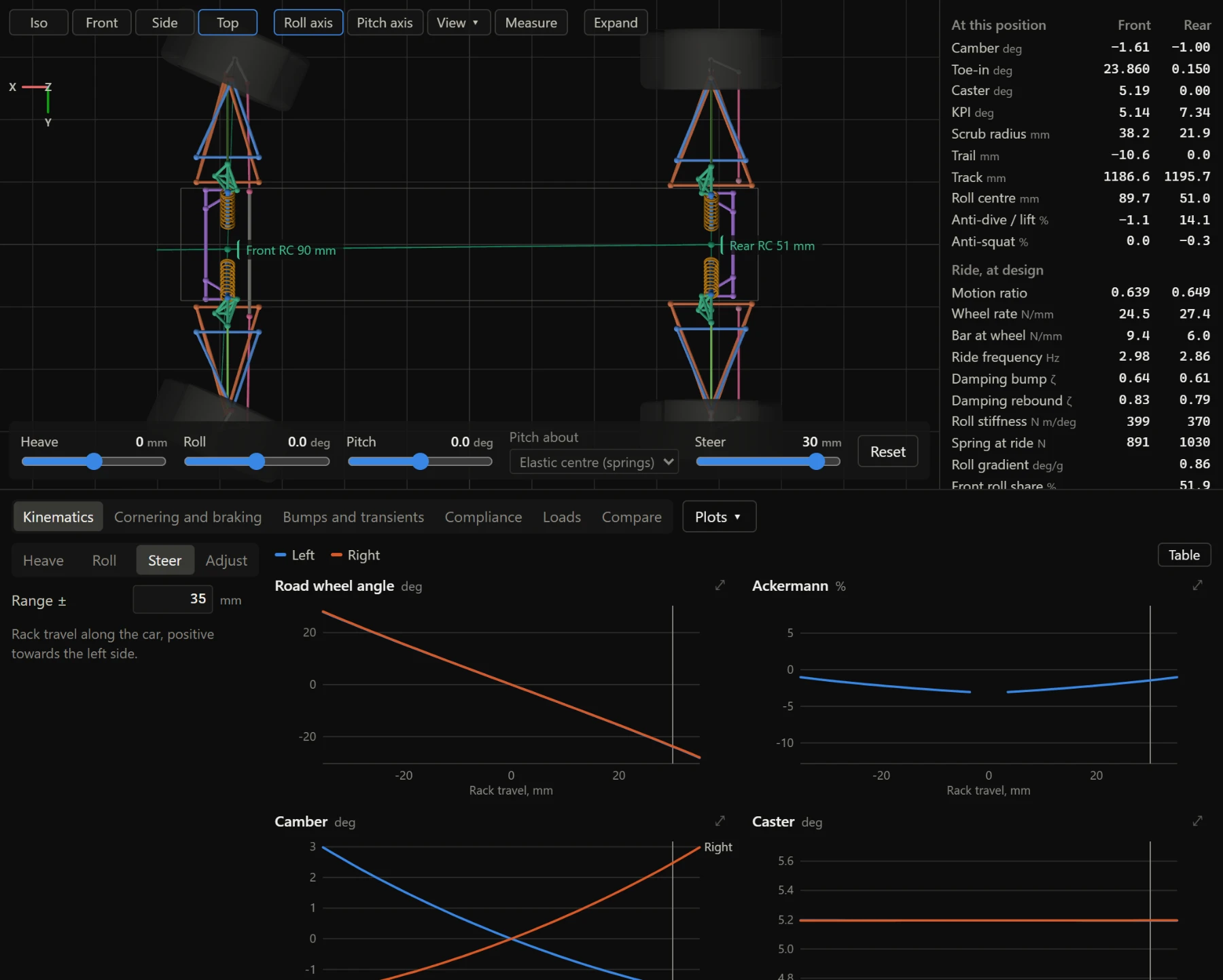
The docs example double wishbone steers almost in parallel, and very slightly the wrong way. With 20 mm of rack travel the inner wheel steers 15.55° and the outer 15.64°, which is -2% Ackermann; true Ackermann would put the inner wheel at 19.61°. At 30 mm of rack travel it is -1.4%.
Which to choose
Ackermann matters most at low speed and large steer angles, such as hairpins and parking. At speed both front tires run at slip angles that dwarf the geometric difference, and the more heavily loaded outside tire needs a larger slip angle to make its share of the force, which argues for less Ackermann, or even anti-Ackermann on cars with high lateral load transfer. Racing cars, Formula SAE cars included, span the whole range, so it is worth checking on the steering sweep rather than at a single angle.
How the geometry sets it
The steering arms and tie rods set Ackermann. For a rack behind the axle, the classic rule of thumb angles each steering arm inward so that, seen from above, a line from the kingpin axis through the outer tie rod point passes through the middle of the rear axle; that gives close to true Ackermann at small angles. Angling the arms inward less moves toward parallel steer, and angling them further gives more than 100%. The rack's fore and aft position and length change the result too. The tie rod's height also sets bump steer, so the two are tuned together.
Related
- Scrub radius and trail: the other steering-axis numbers
- Bump steer: set by the same tie rod
- Methodology: how steer angles are solved