 opensus
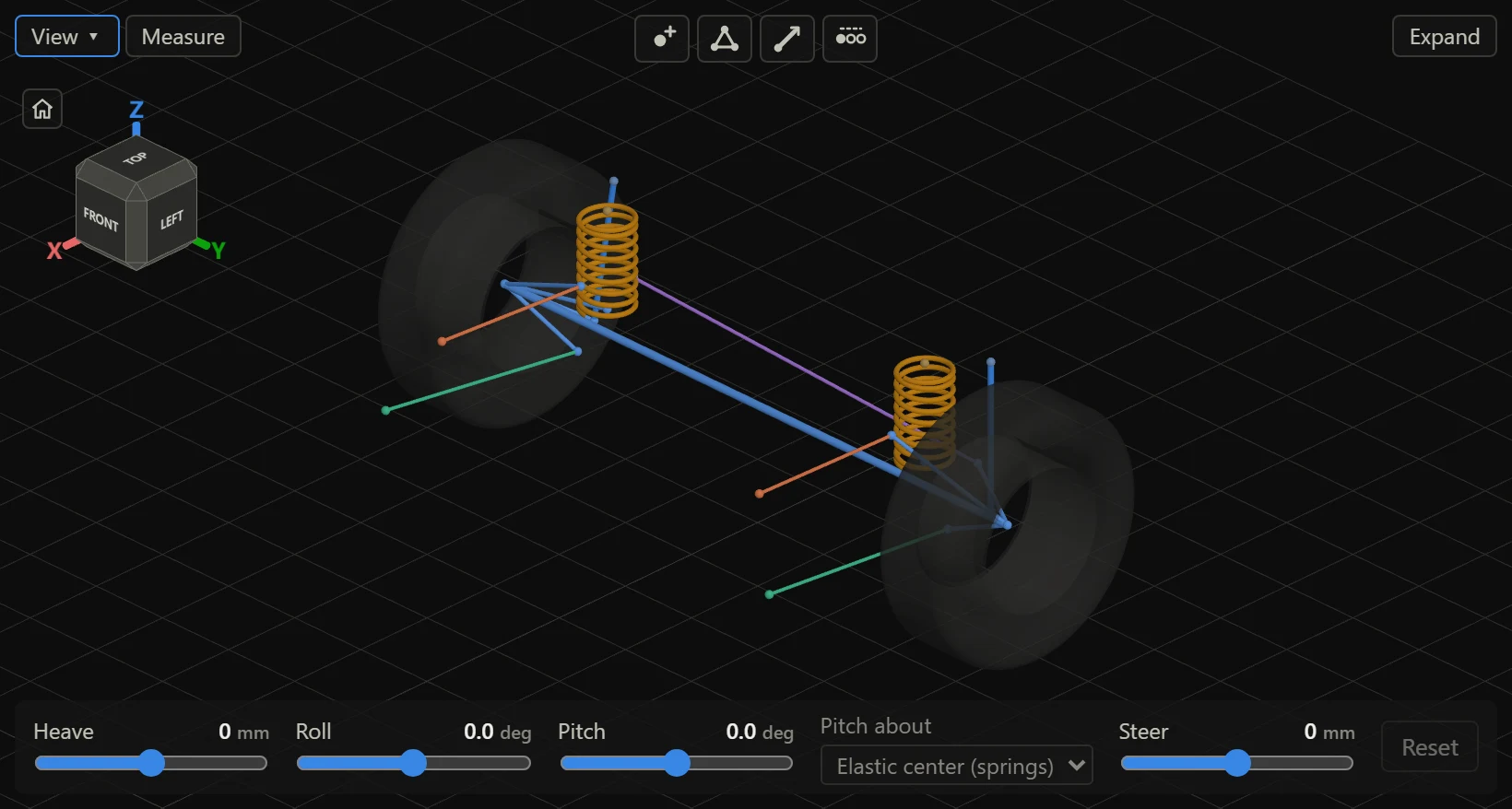
5-link live axle
A lower and an upper trailing link on each side, and a Panhard rod: five links. On a rigid housing, five rigid links leave only heave, and the axle cannot roll. A real 5-link rolls because its bushings give: in roll, the links on each side want the housing at a different pinion angle, and the rubber takes up the difference. This is called bind.
The example is built from parts as Live rear axles describes, and its hardpoints and results are on the example page. In this layout, one housing carries both rear wheels. In the independent five-link layout, a separate set of links guides each wheel.
Bushings are required
A 5-link needs rubber bushings on its trailing links. Without them it is locked in roll: the status reads Needs attention, the wheels can only move together, and the whole-car analysis will not run.
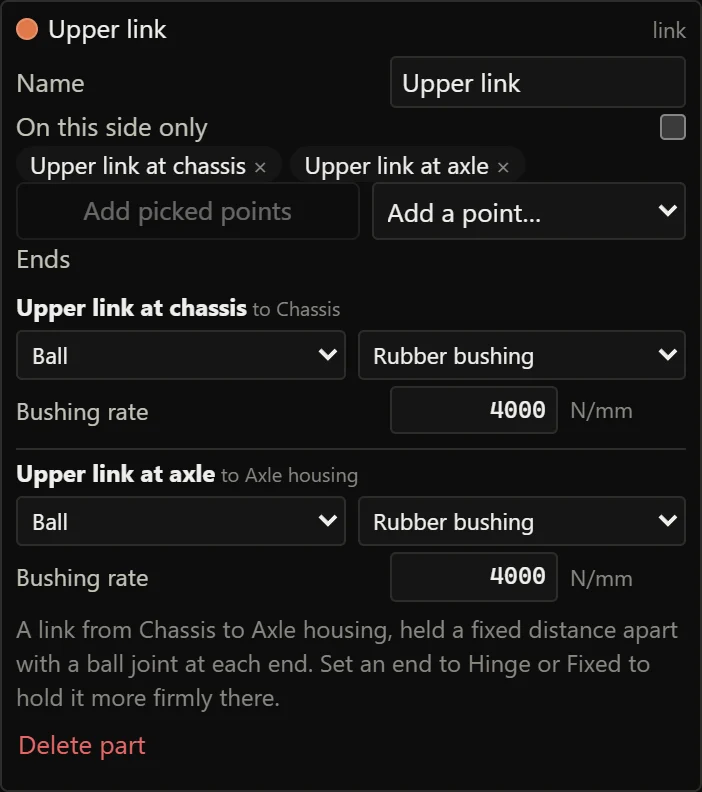
To add one, open the link's card under Parts and links, and under Ends set each end's second choice, beside Ball, to Rubber bushing with its rate in N/mm. The setting belongs to the point, so the part the link meets shows it too. A bushing gives at that rate in every direction; rubber bushings has the details.
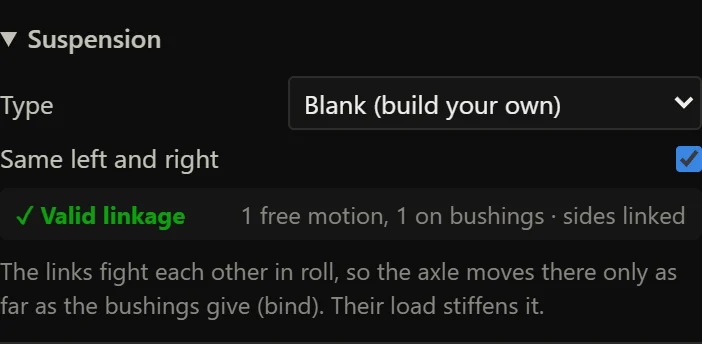
With them, the status reads 1 free motion, 1 on bushings: heave is free, and roll happens only as far as the bushings give.
What the bind costs
In 1.5° of axle roll, each of the example's links (4000 N/mm at each end) stretches or shortens by about half a millimeter, upper and lower against each other.
As the axle rolls, the rubber bushings deform and resist that movement. This adds to the axle's roll stiffness. The example's bushings add about a fifth to the rear axle's roll stiffness, and stiffer bushings add more, in proportion to their rate. The whole-car model includes it, and so does Loads: in a turn, the upper and lower links of a side pull against each other with the bind preload, on top of what the cornering force puts through them.
Bushings matter elsewhere too: Compliance and Loads use each one's rate, where other joints have a reference stiffness.
What the links set
- Roll center is where the Panhard rod crosses the centerline, as on the 3-link. The example's rod sits 150 mm behind the axle line, where it is measured, so it reads a little above the rod.
- Anti-squat comes from the angle between the upper and lower links in side view: they converge on a side-view instant center ahead of the axle. Change the upper links' angle to move it.